
Viral launch videos for moon-shot founders 🌸
Flowjam partners with AI founders and startups aiming for the moon, to create story-driven launch videos to build hype and show the world what they're building.

Full PortfolioBlog
Flowjam works with some of the most successful AI founders in the world after only launching in 2023.
Copyright 2026. Flowjam Ltd.
Copyright 2026. Flowjam Ltd.
Micro SaaS Examples 2026: 27 Bootstrapped Apps at $1K-$200K MRR
27 real micro-SaaS examples with verified 2026 revenue (Carrd $360K ARR, Photo AI $132K MRR), the patterns behind them, and a 30-day framework to validate and build your own.

Last reviewed and updated: October 4, 2026.
the short answer
Carrd earns roughly $1M a year run by one founder — that is micro-SaaS: a one or two person tool that solves a single problem well enough to reach $1K-$200K+ MRR. Below are 27 real examples with 2026 revenue (public founder figures), the patterns behind them, and a 30-day framework to validate your own, most built for under $1,000.By the Flowjam team · Updated September 2026
Last Updated: June 28, 2026
Marc Lou made $1.03M over the past year from a portfolio of micro SaaS products he built solo. Pieter Levels runs Photo AI at $132K MRR by himself. These aren't outliers, they're the visible top of a wave of founders building profitable software without investors, a cofounder, or a five-year plan.
Micro SaaS is the clearest path to a real software business you own outright. Solo founders are building $10K-$60K/month products in months, not years, and the proof is public: real founders posting real revenue.
This is 27 micro SaaS examples with verified 2026 revenue, the patterns behind why they work, and a 30-day framework to validate your own. Not ideas, real businesses printing money right now.
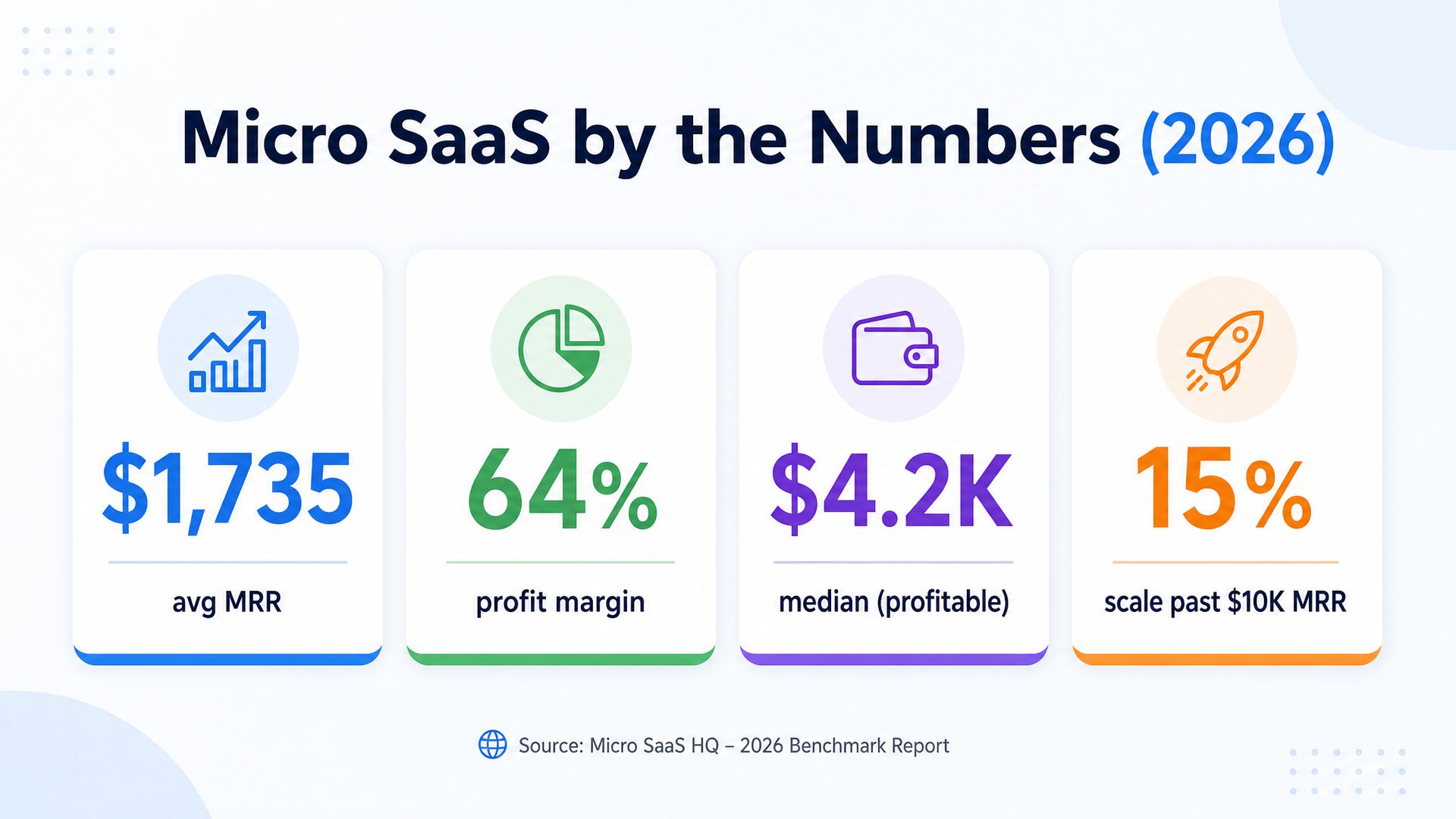
Table of Contents
- Micro SaaS by the Numbers (2026)
- 27 Micro SaaS Examples with Verified Revenue
- 10 Deeper Breakdowns
- What the Winners Have in Common
- The 30-Day Validation Framework
- Build Timeline & Cost
- Frequently Asked Questions
Micro SaaS by the Numbers (2026)
Before the examples, the honest landscape. The average micro SaaS earns about $1,735 MRR at a 64% profit margin. The median profitable product does roughly $4.2K MRR (~$50K/year). The median product overall earns closer to $500/month, most never break out. But about 15% scale past $10K MRR, and the top 1% clear $50K+. The highest-margin categories are dev tools (76.8% margins), analytics (~$3K average MRR), and productivity (63%).
The takeaway: micro SaaS isn't a lottery ticket, but it's a winnable game with strong unit economics. The winners below show what the top of that distribution looks like.
27 Micro SaaS Examples with Verified Revenue
| Product | What It Does | Revenue | Team |
|---|---|---|---|
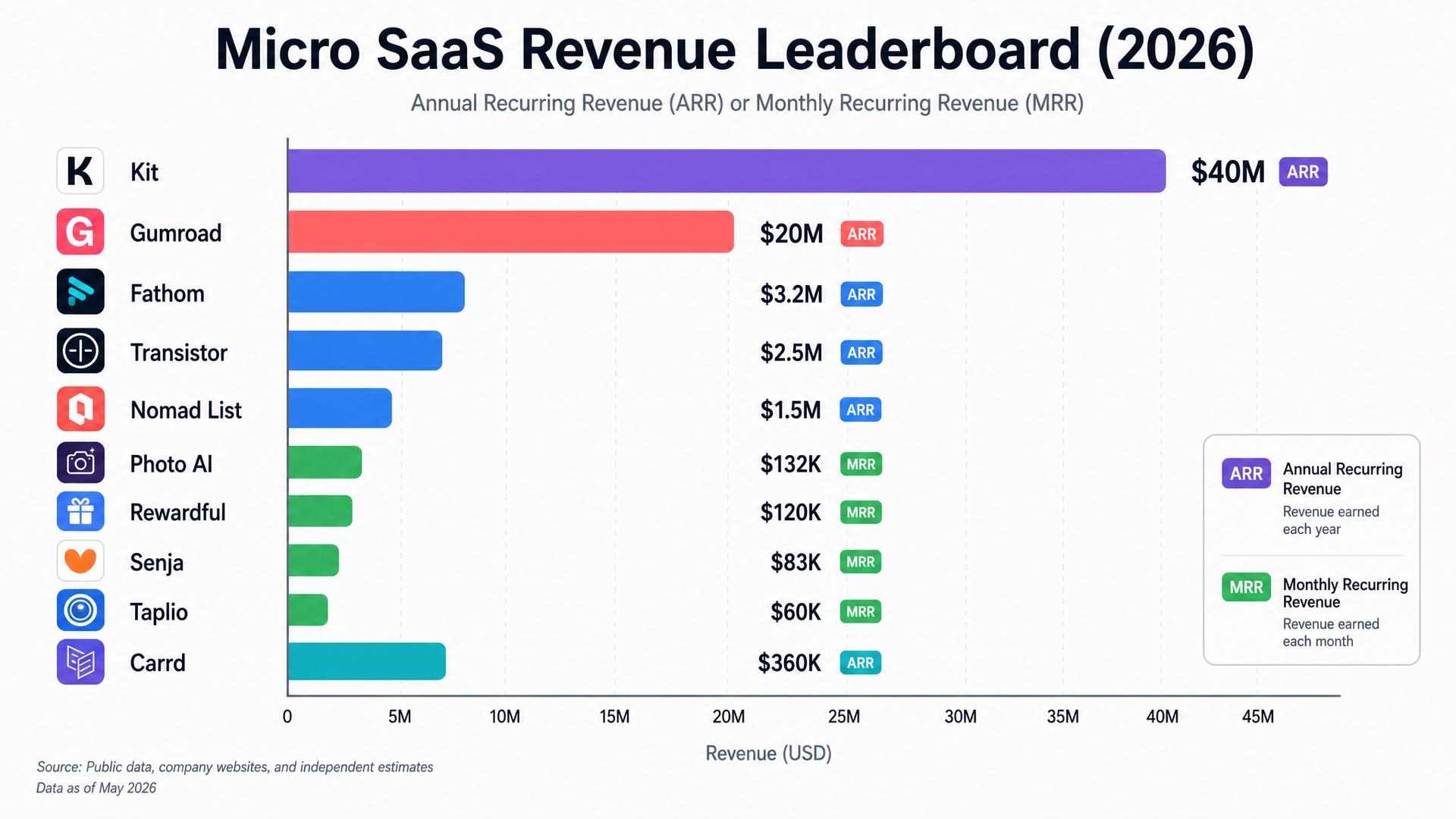
| Photo AI | AI photo generation | $132K MRR | Solo |
| Nomad List | Remote-work city data | $1.5M ARR | Solo |
| Senja | Testimonial collection | $83K MRR | 2-3 |
| Carrd | One-page sites | $360K ARR | Solo |
| ShipFast | SaaS boilerplate | $20K/mo | Solo |
| DataFast | Analytics for founders | $15.8K MRR | Solo |
| Taplio + Tweet Hunter | LinkedIn/X growth | $60K+ MRR | Small |
| Bannerbear | Image-generation API | $60K MRR | Solo+ |
| Kit (ConvertKit) | Creator email | $40M+ ARR | Team |
| Plausible | Privacy analytics | $2M+ ARR | Small |
| Fathom Analytics | Privacy analytics | $3.2M ARR | 2 |
| Testimonial.to | Video testimonials | $40K MRR | Solo+ |
| ByeByeAI | AI-detection tool | $4K MRR (3 wks) | Solo |
| Transistor.fm | Podcast hosting | $2.5M ARR | 4 |
| Simple Analytics | Privacy analytics | $55K MRR | 2 |
| Gumroad | Digital sales | $20M+ ARR | Team |
| Hypefury | Social scheduling | $800K ARR | Small |
| Linkody | Backlink tracking | $200K ARR | Solo |
| Pikzels | AI thumbnails | $25K MRR | Solo |
| Reflect | Networked notes | $30K MRR | 2 |
| Rewardful | Affiliate tracking | $120K MRR | Small |
| Tally | Free form builder | $60K MRR | 2 |
| Riverside-style niche tools | Vertical workflow | $10-30K MRR | Small |
| Headlime-style AI copy | AI copywriting | $25K MRR | Small |
| Inbox/email niche tools | Email scheduling | $30K MRR | 2 |
| SEO audit micro-tools | Automated audits | $20K MRR | Solo |
| Social-proof widgets | Conversion widgets | $15-25K MRR | Small |
Revenue figures are from founders' public reporting (build-in-public posts, interviews, and revenue dashboards) and are directional snapshots, several of these founders update their numbers openly.
10 Deeper Breakdowns
1. Photo AI ($132K MRR, solo). Pieter Levels rode the AI-image wave with a focused consumer product. The lesson: ride a platform shift (generative AI) with a simple, paid product, and ship before the space crowds.
2. Marc Lou's portfolio ($1.03M in the last 12 months). ShipFast ($20K/mo), DataFast ($15.8K MRR), ByeByeAI ($4K MRR in three weeks). The lesson: a portfolio of small bets compounds, and building in public is the distribution.
3. Carrd ($360K ARR, solo). AJ built a one-page website tool and kept it deliberately tiny. The lesson: a single, sharp use case at a low price scales on volume with near-zero support.
4. Senja ($83K MRR). Wilson Wilson and Olly Meakings built testimonial collection into a category, reaching $1M ARR in under four years. The lesson: pick a painful, universal job (social proof) and own it.
5. Nomad List ($1.5M ARR, solo). Pieter Levels started it as a spreadsheet in a "12 startups in 12 months" challenge. The lesson: launch embarrassingly small, let the community make the data valuable.
6. Bannerbear ($60K MRR). Jon Yongfook went $0→$10K MRR building an image-generation API for developers and marketers. The lesson: usage-based APIs scale with customer success and need little support.
7. Taplio + Tweet Hunter ($60K+ MRR). Tibo built growth tools for LinkedIn and X. The lesson: build for a platform's creators while the platform is hot, and bundle adjacent tools.
8. Fathom Analytics ($3.2M ARR, 2 people). A privacy-first Google Analytics alternative. The lesson: position sharply against a giant's weakness (privacy, simplicity, speed).
9. Rewardful ($120K MRR). Affiliate tracking that plugs into Stripe. The lesson: build the boring infrastructure other SaaS companies need and integrate deeply with their stack.
10. ShipFast ($20K/mo, solo). A one-time-purchase SaaS boilerplate. The lesson: sell to the community you're already in (indie hackers), and one-time pricing can beat subscriptions for the right product.
Seeing the pattern? Every one of these started with a validated problem and a fast launch. The 12-week SaaS launch playbook is the exact sequence to go from idea to first paying users.
What the Winners Have in Common
Across all 27, the same patterns repeat:
- One sharp use case. None of them are platforms. They do one thing for one audience and do it well.
- Built in public. The biggest names (Levels, Marc Lou, Tibo) turned transparency into distribution, their revenue posts are the marketing.
- Ride a wave. The fastest growers (Photo AI, ByeByeAI) caught a platform shift early. AI is the current wave.
- High margin by design. Minimal support, automated delivery, no sales team. 60-80% margins are normal.
- Distribution baked into the product. Testimonials, widgets, and one-page sites get shown to new users by their own customers.
- Niche beats broad. "Analytics for indie founders" beats "analytics." The narrower the wedge, the easier to rank, sell, and support.
The 30-Day Validation Framework
Before you build, prove demand in 30 days:
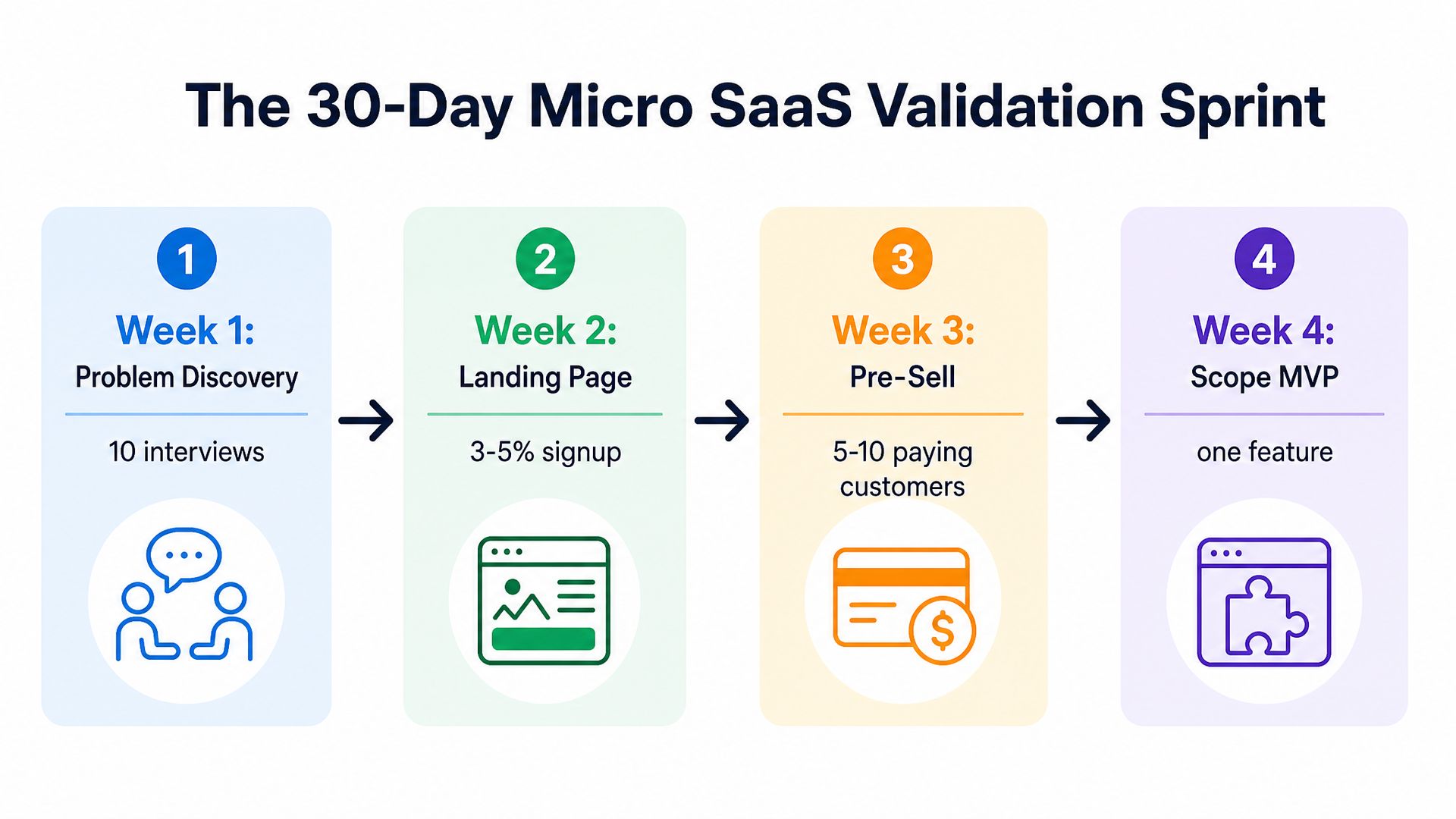
Week 1 — Problem discovery. Find 3 niche communities (Reddit, Slack, Discord). Run 10 problem interviews: "What's the most frustrating part of [workflow]?" Look for 7+ people describing the same pain.
Week 2 — Landing-page test. Build a simple page with one clear value prop and an email capture. Drive 200-500 targeted visitors. Target a 3-5% signup rate.
Week 3 — Pre-sell. Email your signups a founder's deal (50% off lifetime for early access) with a real payment link. Target 5-10 people willing to pay before the product exists, that's the only validation that counts.
Week 4 — Scope the MVP. Interview your pre-payers. Find the ONE feature they must have. Scope a 4-6 week build, nothing more.
Build Timeline & Cost
Modern micro SaaS winners ship MVPs in 2-8 weeks and reach first revenue in 1-3 months. A lean stack (Next.js or Remix + Supabase + Stripe + Vercel) runs $30-150/month. Total cost to launch: typically $500-$1,500. The constraint is rarely money or code, it's picking a real problem and getting to a payment fast.
Picked your idea? The launch is where most micro SaaS dies.
A great product nobody hears about earns $0. See our 12-week SaaS launch playbook → to get your first users.
Frequently Asked Questions
What is a micro SaaS?
A micro SaaS is a small, focused software-as-a-service business, usually run by a solo founder or tiny team, targeting a narrow niche with $1K-$100K in monthly recurring revenue. It's bootstrapped and profit-first, the opposite of venture-scale SaaS.
How much money do micro SaaS businesses make?
The average micro SaaS earns about $1,735 MRR at a 64% profit margin, and the median profitable product does roughly $4.2K MRR (~$50K/year). About 15% scale past $10K MRR, and top performers like Photo AI ($132K MRR) and Carrd ($360K ARR) show the ceiling.
What are the most profitable micro SaaS categories in 2026?
Dev tools lead on margins (76.8%), analytics products average ~$3K MRR, and productivity tools run ~63% margins. AI-powered tools are the fastest-growing category as founders ride the generative-AI wave.
How long does it take to build a micro SaaS?
Winners ship an MVP in 2-8 weeks and reach first revenue within 1-3 months. With a modern stack (Next.js, Supabase, Stripe) and AI-assisted coding, a focused first version is faster to build than ever, the bottleneck is validation, not code.
Do I need to be a developer to build a micro SaaS?
No. No-code tools (Bubble, Webflow, Airtable) and AI coding assistants let non-technical founders ship. That said, technical skill speeds iteration. Roughly 40% of successful micro SaaS founders are non-technical.
How do I find a micro SaaS idea that will actually make money?
Look for narrow, painful, recurring problems in communities you're part of: manual workflows, expensive enterprise tools used for one feature, or gaps between two popular products. Then validate with the 30-day framework above, real pre-payments before you build.
Ready to launch? See our 12-week SaaS launch playbook, our product-led growth playbook, and waitlist landing page examples to get your first users.
AP
About the author
Adam Petty
Founder, Flowjam
Adam is the founder of Flowjam, where he helps startups turn ideas into launch videos, product demos, and ads with AI video. He writes about AI video production, creative workflows, and go-to-market for early-stage teams.


Launch videos for
moon-shot founders.

About
We're a video production studio partnering with AI founders and startups. We make launch videos to show the world what you're building.
London / San Francisco
Made with love from London / San Francisco. Collaborating with clients worldwide.
Contact
Adam Petty
Founder
adam@flowjam.com
Founder
adam@flowjam.com